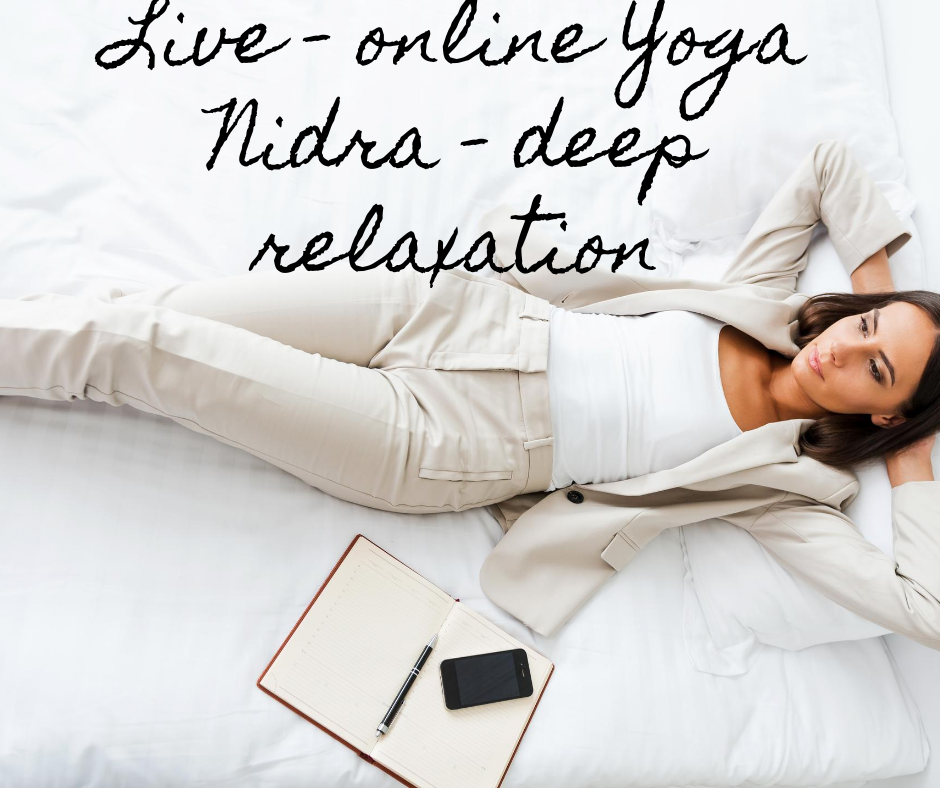
Yoga Nidra, also known as dynamic sleep, prompts the body to relax deeply while the mind remains inwardly alert and one 30-minute practice equals approximately two hours of deep sleep. Yoga nidra works by gently guiding you through the four main stages of brain wave activity – beta, alpha, theta, and delta a state between wakefulness and sleep. Live your best life and join our “Live-online” Yoga Nidra classes to release stress and tension and experience the ultimate relaxation technique. Each class is followed by Q&A with Snr Yoga Ayurveda Therapist.
Yoga nidradeep relaxation or yogic sleep is a state of consciousness between waking and sleeping, like the “going-to-sleep” stage, typically induced by a guided meditation. There is evidence that yoga nidra deep relaxation helps relieve stress. We assist people to recover frompost-traumatic stress disorder using the ancient worldwide techniques from India. Prior studies indicate that yoga nidra helps to stabilise blood sugar levels; alleviate PMS symptoms, depression, and anxiety; and combat PTSD
Yoga Nidra “Live-online” classes via Zoom
Wednesdays
1-1:30pm, followed by Q and A and community chat
$20 for one month (normally $40)
Once you register, you’ll receive instructions on how to access our Live-Yoga Nidra class on Zoom, which meets every week
Zoe is a Senior Yoga Ayurveda Therapist and founder of Yoga Works for Over 40s focuses on people over the age of 40. Experience the transformational and evolving needs of each individual. We help you to develop an awareness of what you take in via your senses.
Yoga and Ayurveda combined look at the quality of what you can and cant digest through your senses (mouth, eyes, ears, nose, skin. This knowledge will help you to improve the health and quality and balance your life by living intune with nature.
encouraging you to ‘live younger’
Yoga therapy is fast becoming an accepted health modality throughout the world. We work with people who experience a wide range of conditions.
receive guidance, expertise, community & ongoing support
What you get
Q & A community connection and be a part of our growing community
Snr Yoga Ayurveda therapist with over 30 years of experience
In the deepest state of sleep (similar to Yoga Nidra) the brain produces theta (4-7 hertz) and delta waves (1-3 hertz) read more
Take positive steps to heal from trauma
Yoga nidra is proven to help reduce stress and anxiety.
The practice of yogic sleep gives the body time to rest, recover and restore, which thereby brings down inflammation and improves the function of the immune system.
A recent study by US National Library of Medicine found “Patients with menstrual irregularities or psychological problems improve significantly in the areas of their wellbeing, anxiety and depression”
Yoga nidra improves sleep and reduces insomnia. Insomnia and sleep deprivation contribute to mental disorders, stress management (or lack there of), and immune suppression.
“A recent study published in the Indian Journal of Physiology and Pharmacology found yoga nidra may reduce the symptoms of diabetes and help control blood glucose levels.”
The work done in yoga nidra with a Sankalpa (an intention or positive affirmation) can facilitate life altering changes in one’s thought patterns, relationships and achievements
Please read our tips to prepare for your Yoga for over 40’s one week ‘live’ online classes.
What you need:-
Download Zoom link and create a free account
Log in each week via Zoom internet
Take yourself to a quiet and private, draft free environment
Chair or mat to lie on
Eye and body covering
Only have a light lunch, and reframe from coffee or tea
For more information call Zoe on +61 407 956 071 – click here to discover our online classes
SIGN UP NOW
Sign up now and receive 12 classes a month for $69 plus 3 exclusive bonuses
#1 Get instant access to our closed Facebook group with 60 recorded Yoga Therapy classes
#2 Ayurveda easy ways to improve your digestive system, boost energy and improve your immunity
#3 Free Yoga Therapy consultation 30 minutes
Sign up now and receive 12 classes a month for $69 plus 3 exclusive bonuses
#1 Get instant access to our closed Facebook group with 60 recorded Yoga Therapy classes
#2 Ayurveda easy ways to improve your digestive system, boost energy and improve your immunity
Many of our clients are complaining of a sore neck and back with disturbed sleep patterns from working at the dining room table. To relieve aches and pains while refreshing your pineal gland try our Chair Yoga lunchtime class. Making a commitment to attend this class encourages you to stop in the middle of the day. It is not unusual for people to sit on a chair for up to eight hours in front of a screen.
Prolonged sitting is a health risk
Sitting for prolonged periods of time is a risk to your health. It is often accompanied by poor posture and inappropriate ergonomics. In view of this, it is important to understand how to keep your spine, breathing, circulation and muscles tension free.
Ensure you have the correct desk and chair height, lighting and that laptops are inline with your eyes. Because sitting with poor ergonomics for hours at a time locks the body into abnormal positions creating pain and strain.
Are you one of those people with a sore neck, shoulders or back?
Live smarter with Yoga when using technology
The pineal gland is for creativity and intuition
We want to share with you the how the glow of a digital screen suppresses the endocrine and pineal gland in the brain.
By the way, melatonin produced in the pineal gland is activated by darkness and is suppressed by light.
Electromagnetic fields released by mobile phones and other wireless devices suppress the pineal gland. Also the happy chemicals in the brain are transformed into melatonin in the pineal gland.
Melatonin affects the stress hormone levels called cortisol. Low melatonin levels increase cortisol which disrupts our sleep patterns. Sleep disturbance occur after a busy day in front of a screen. A healthy pineal gland is crucial to healthy cell growth.
Effects of an impaired pineal gland are:-
Mood swings, depression and seasonal disorders
A decrease against free radicals.
Triggering the ageing process
Disturbed sleep patterns
Ancient art traditions depicted the pineal gland as associated with enlightenment and mortality. It is a chakra energy centre, source of intuition and clairvoyance. The pineal gland provides perceptions beyond plain sight.
Whether we look at the pineal gland from a philosophical or scientific point of view it plays a vital role in mental, physical and spiritual health.
The Chair Yoga lunchtime class relieves stress, aches and pains and our Sleepy time Class improves the quality of your sleep.
You will wake up in the morning with better energy and you will enjoy life more.
will increase by simply integrating Yoga combined with Ayurveda into your daily routine.
Dangers of Modern Living
Have you heard the saying that with all the wealth in the world you can’t buy good health?
Furthermore we really do need to take responsibility for this vehicle our body, however most modern-day experiences are spent looking at a screen.
Every day we encouraged to ingest continuously, in a gluttony and unconscious way through our senses – eyes, ears, nose, mouth and skin. Read the effects of modern technology in lockdown
Yoga for over 40s (online) classes
Busy people will re-energise, reset and recalibrate life in a digital world with our Yoga Works for over 40s (online) classes.
Our ChairYoga Lunchtime Therapy classes encourage you to take a break and connect with how you are using your body. Gain access to our private Facebook group Yoga Works Better with Ayurveda to watch class replays. There is a Q&A session after the Lunchtime Chair Yoga therapy.
Our classes show you how to integrate these natural healing techniques into your schedule. You will come back to a state of balance and calm your nervous system. Read how to prevent technology from controlling your life.
Computers and Yoga Ayurveda are the perfect combination
Personalised Yoga Ayurveda therapy programs
Have your own personalised Yoga therapy program that fits into your your daily life.
Ayurveda views each person as totally unique and not one practice will suit all people.
Zoe our Yoga Ayurveda therapist is a Hi-Tech-Yogi. She is the founder of Computer Coach Australia. Zoe has learnt ways to keep healthy with a busy professional life. She combines Yoga and Ayurveda and will show you how to keep healthy with a busy schedule.
Ayurveda provides an awareness of your digestive capabilities.
Anorexia is a mental health disorder which belongs to a group of behavioural disorders. This is because the person is often physically healthy before the onset of the disease. Social media has a lot to answer for regarding an addictive behavioural disorder.
Its symptomatology appears to disturb the normal functioning of a young person in the psychological, family and social settings. Anorexia is, after bulimia, the most common eating disorder in puberty and adolescence. It is mainly a disease of the female population – a disease of women and young girls. The word “anorexia” in free translation means loss of appetite.
Visible physical symptoms are a consequence, not the cause of the disorder
Adolescent girls are increasingly suffering from eating disorders such as anorexia, and social media is largely responsible for this.
Anorexia in Teenage Girls
Soothe social media habits with Yoga therapy
Experts have found that young people have become dependent on social networks which undoubtedly negatively affects health. This is both physically and mentally and Yoga therapy can help to reverse these impacts.
There are more teenage girls who are unhappy with their appearance. They will compare their body to the people and celebrities they see online. As a result severe dieting regimes can be adopted. And so more and more suffer from anorexia or bulimia.
Several researchers have highlighted that spending too much time on social media leads to a one-sided focus on appearance, habits and behaviour. Teens feel like they need to look and behave in the same way as girls who they follow Instagram.
Self-image and Social Media
Girls visit websites in search of diets
Experts have found that more and more girls visit websites in search of diets. The most disturbing, is the fact that some people visit pages that encourage people to have an eating disorder. Consequently, they can ask for advice on how to starve and how to get into the state of extreme skinny-ness.
There was also a series of social media sites that target anorexia called so-called Pro-Ana (for anorexia) and Pro-Mia (for bulimia). For the purpose of persuading girls and women to persevere in their disorder. As well as inspire them to achieve weight loss. Here they can find pictures of models and celebrities looking like skeletons. As well as tips and techniques to stay dangerously skinny.
To protect teenagers and their platform (from future litigation) some social media sites like Instagram, Tumblr and Pinterest have actually banned the hashtags from their platform. As well as turning off the number of likes on some posts. Recently social media platforms have turned into publishers and block certain posts and sites from exposure to direct the consumer in line with their own views.
Read what Instagram hashtags such as #thinspo for thin inspiration have been banned here.
The “most dangerous” part of the Internet is precisely the social media community. Namely, the girls, through communication with others, receive great support and strong encouragement for extreme forms of behaviour. Girls with eating disorders feel ashamed and flee from their real environment. Also on the Internet there are whole groups of like-minded people who will “understand” them. The danger is they are probably further encouraging unhealthy and dangerous behaviour.
Orthorexia obsession with healthy nutrition
Healthy nutrition has been gaining momentum in all life spheres in recent years. Firstly, the media bombards followers with articles and research on the positive effects of eating natural foods. Such as vegetables, fruits, eating high-quality meat or reducing meat intake, industrial foods, and foods rich in sugar. This is really good until it becomes an obsession where anorexia or orthorexia sets in. Like any other obsession, the obsession with eating healthy foods has got its name – orthorexia.
We are not talking about people who choose to lead a healthy lifestyle when it comes to their diet. Also there is an obsession with fast-food, the complete opposite. Even more than the dependence on healthy eating is what happens if they ingest a “forbidden” food into their body.
Orthorexia or anorexia are a based on a need to control life
Most people who suffer from orthorexia appear skinny in the same way as anorexic people do. As a result, the term orthorexia can be confused with anorexia. However they do have several common consequences on the human body. Those with anorexia and orthorexia restrict the intake of food into the body. Both follow various diets. In contrast people with orthorexia consume exclusively healthy foods in order to be “healthier”.
But as with anorexia, a person suffering from orthorexia wants complete control of their life. Likewise they desire a certain weight (which is often imposed on them by others and which they have accepted). This is all in attempt to raise self-confidence to feel better about themselves.
Orthorexia an obsession with healthy nutrition
Exactly the opposite happens and the self confidence can crash. When finally putting down social media a rush of blocked emotions rise to the surface followed by anxiety. This can result in self medicating by controlling their food intake.
When food becomes the central topic, at any given time and orthorexia develops, the quality of a person’s life deteriorates. This behaviour can become isolating and further exacerbate feelings of anxiety and behavioural problems.
Orthorexia
What Can We Do?
Epidemiological studies by the NIH suggest that the incidence of eating disorders among adolescent girls has increased over the last 50 years read more.
Parents need to be aware that an entire online community can stand behind the problem encouraging their daughter’s diet while negatively effecting their mental health. As well as in some way, regulating access to sites that encourage negative and unhealthy behaviour.
Parents have the potential and ability to prevent the development of eating disorders in young addicts on social media
If you wish to know more about this rather serious subject, please check out the video below:
How Yoga helps you with anxiety
It is so important to develop an awareness of yourself, so as not to alienate yourself from your teenager. With Yoga, Ayurveda and Meditation you will have the opportunity to connect to your feelings and the wisdom of intuition. You will recognise the pause between the inhalation and exhalation and inhalation and develop skills to create pauses in your mind and life. As a result this space in your life provides choice to temper your re-actions.
Problems are exacerbated when feelings or emotions are blocked. Yoga provides the opportunity to meet and uncover blocked emotions in a gentle and loving way.
As a parent serious issues are best not to be neglected or push under the carpet
Social media is very natural for teenagers as they are so used to connecting with others in a digital world (which is less confrontational) – and plays an important role in their lives often perceived as a lifeline. Any confrontation brings out a survival instinct. Real life situations can trigger reactive behaviour and blocked emotions can erupt. Learning to manage thoughts, feelings and emotions is difficult for everyone and a lifelong quest. As a parent role modelling is very powerful way to offer support.
Yoga therapy and overuse of technology
Teenagers can struggle with real life confrontation, especially after spending time in a virtual world with their friends. Some parents have likened the over re-action from the teenager when asked to put down the device, similar to an addiction. Likewise they may only know how to express themselves online and have not developed the skills to manage life’s inevitable experiences.
Yoga therapy provides tools to access emotions and feelings plus an awareness of a need to digitally detox. Managing overuse of technology improves sleep and anxiety is released. This then calms the nervous system. It is not just teenagers who struggle with over using technology. And we have many older people who come to us for help.
As a Hi-Tech-Yogi I am very familiar with both Yoga and Technology. Therefore we address topics such as:-multi-tasking, over using technology and the effects on the pineal gland. Ayurveda the science of life recognises each person is as unique as their DNA. Also each person and relationshipwith social media requires different tools, strategies and goals.
Yoga Therapy live-online classes
Good Morning Yoga therapy class helps to get your body ready for the day in the right way. Set an intention, stretch, strengthen and increase your immunity.
Lunchtime Chair Yoga therapy class brings a welcome break into the middle of your day to connect with your breathing, body posture and the present moment.
Sleepy Time Yoga therapy class is a relaxed and soothing way to clear your mind, calm your nervous system, a form of sleep hygiene to prepare for a restful nights sleep.
We believe it’s important to address these topics with the aim to calming yourself as the parent. Learn to come from a centred and grounded place when dealing with your teenager. Develop strategies to model and integrate technology into every day life in a balanced and responsible way.
Yoga Works for Over 40s has ‘live-online’ classes as well as Yoga Therapy one-on-one practices. Classes address the individual needs of each person.