Author: Zoe

  • Prudence

    Prudence

    Disciplining oneself for a higher purpose – the body is very forgiving – you just need to lube it up by moving in all directions everyday. If you can’t seem to discipline yourself to do this – you need to join up to a regular class. Yoga Ayurveda works on the physical and internal body. What you eat and how you live your life affects your health. In Yoga we learn to listen to the body mind.

    Without health all the wealth in the world won’t save you!

  • The Healing Power Of Yoga For Brain Injuries

    The Healing Power Of Yoga For Brain Injuries

    footprints

    In honor of Brain Injury Awareness month, former pro snowboarder Kevin Pearce talks about how key the practice is to his ongoing brain injury recovery.

    On December 31, 2009, less than two months before the 2010 Winter Olympics in Vancouver, snowboarder Kevin Pearcecrashed his head into an icy half pipe in Park City, Utah.

    The traumatic brain injury (TBI)brought on a 6-day coma, memory loss, mood swings, and vision problems, but Pearce’s discovery of yoga has helped give him new eyes. Quite literally.

    Pearce’s vision problems required glasses all the time, but two months ago, Pearce attended a life-changing yoga class near his home in Carlsbad, California. He drove to the class, wearing his glasses, but found afterward as he drove home, he didn’t need to them for the first time in five years.

    “In no way are my eyes 100 percent better, but it made that big of a difference that I don’t have to wear glasses anymore,” says Pearce, whose story is captured in the 2013 documentary “The Crash Reel.” Since then, Pearce has become a regular, practicing yoga and meditation at least once a day when he’s home and at least two or three times a week when traveling.

    Explore Yoga Poses for the Brain

    image

    Quiet the Mind, Heal the Brain

    How could one yoga class have such powerful effects? Former representative Gabrielle Giffords has also been quoted saying yoga is a key part of her therapy recovering from that 2011 gunshot wound to the head. Kim Greene, an injury prevention specialist at the Vail Valley Medical Center in Colorado, isn’t surprised. Greene’s son, Jeremy, suffered a severe TBI in a 1999 car accident when he was 16 years old, and she says that’s when both she and her son found yoga and meditation.

    “The practices help you use your brain in a different way to calm it down and to focus,”Greene said. “I think that’s for all of us, but when you have a TBI, your brain is going in 100 different directions at one time, and the yoga and meditation helps to slow it down and bring a calmness.”

    See also Yoga Helps Vets With Brain Injury

    image

    Yoga and Meditation Program for Brain Injury Survivors

    “Finding yoga and that ability to be exercising and be moving, but at the same time be meditating and be calm and be so relaxed and so mellow, has been so helpful and healing for me in the most amazing way,”Pearce said. “It has changed my life in a way that I could have never imagined, so I want to share what I have found with the rest of the world.”

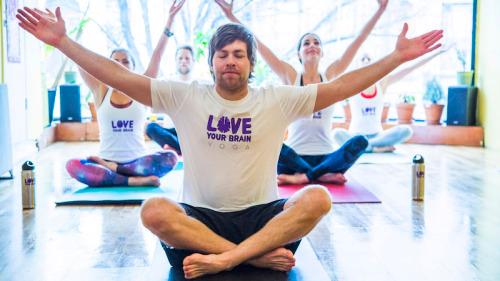
    The impact was so real for him that he enlisted his brother Adam and started The LoveYourBrain Foundation in 2014. In honor of March, Brain Injury Awareness Month, the new nonprofit is leading a monthlong yoga and meditation fundraising campaign. Their aim is to partner with at least one studio in every state to offer a donation-based class. All of the money raised will help grow LoveYourBrain’s flagship yoga program, supporting affordable yoga and meditation classes tailored to the needs of traumatic brain injury survivors.

    Interested in participating? Learn more about the LoveYourBrain Foundation and the March yoga fundraising campaign.

    See also The Big Brain Benefits of Meditation

    Kim Fuller is a freelance journalist and yoga instructor based in Vail, CO.

    Yoga JournalMarch 30, 2015
    image
  • Sleepasana

    Sleepasana: Yoga Can Help You Sleep


    You’ve tried chamomile tea and melatonin, you’ve even sprayed your pillow with lavender oil, but you still can’t sleep. Believe it or not, yoga can help. A Harvard study on insomnia found that people who consistently practiced yoga for just eight weeks enjoyed significantly better sleep—both their length of slumber and its quality improved.

    Approximately 50 to 70 million Americans experience chronic sleep disorders that interfere with their health in more ways than one. Less sleep equals more stress, and your body doesn’t get enough time to repair on a cellular level, which can lead to everything from plain old grumpiness to serious diseases. The Institute of Medicine lists “hypertension, diabetes, depression, and obesity, as well as cancer, increased mortality, and reduced quality of life and productivity” as just a few of the problems it can cause. But you already know how important sleep is—so here’s one more thing you can do about it.

    Jillian Pransky, the director of the Restorative Yoga Teacher Training program for YogaWorks says, “Yoga offers tools to get rejuvenating sleep and regain the healing properties of sleep during the day.” Instead of checking Instagram one last time before bed, start practicing these three poses.

    Child’s Pose

    Start in a tabletop position with your wrists underneath your shoulders and knees underneath your hips with your big toes touching. Shift your hips back toward your heels as you stretch your hands in the opposite direction; gently creating more space in the spine. Rest your forehead on the floor, or on a block or firm pillow. Hold for one to five minutes to calm the nervous system and relieve stress.

    Supine Twist

    Lie on your back and hug your knees in toward your chest. Bring your arms out into a T and lower your knees down to the right, keeping them in line with the navel to stretch the lower back. Hold for one to five minutes and repeat on the other side to ring out spinal tension, open up the diaphragm, and improve breathing.

    Legs Up the Wall with Extended Exhale 

    Sit with your right hip up against the wall or the headboard of your bed, with your hands behind your back for support.  Slowly bring your legs up the wall as you lower onto your back, with your hands by your sides. If your hamstrings are tight, your hips may be a few inches away from the wall. Take a deep inhale through the nose, to the count of four, completely inflating the lungs. On the exhale, slow down your breath and empty to a count of eight until the navel contracts back into the spine.  Stay here, continuing this breathing pattern, for five to 10 minutes to calm the mind.

    Think of these poses as restorative meditation, focusing solely on your breath as you inhale and exhale. Resist any temptation to lie on your back, hold your iPhone in the air, or think about tomorrow’s meeting. Because breathing in and out just might be the easiest way to sleep better. 

    https://www.yahoo.com/beauty/sleepasana-yoga-can-help-you-sleep-95759042143.html

Call now